
Renewed Your Passport? Your UK ETA or Canada eTA May No Longer Work
Renewing your passport can silently break a valid looking UK ETA or Canada eTA. If you travel visa-exempt, check every authorization before your next flight not at the boarding gate.
 Shadrach Oloyede17 min read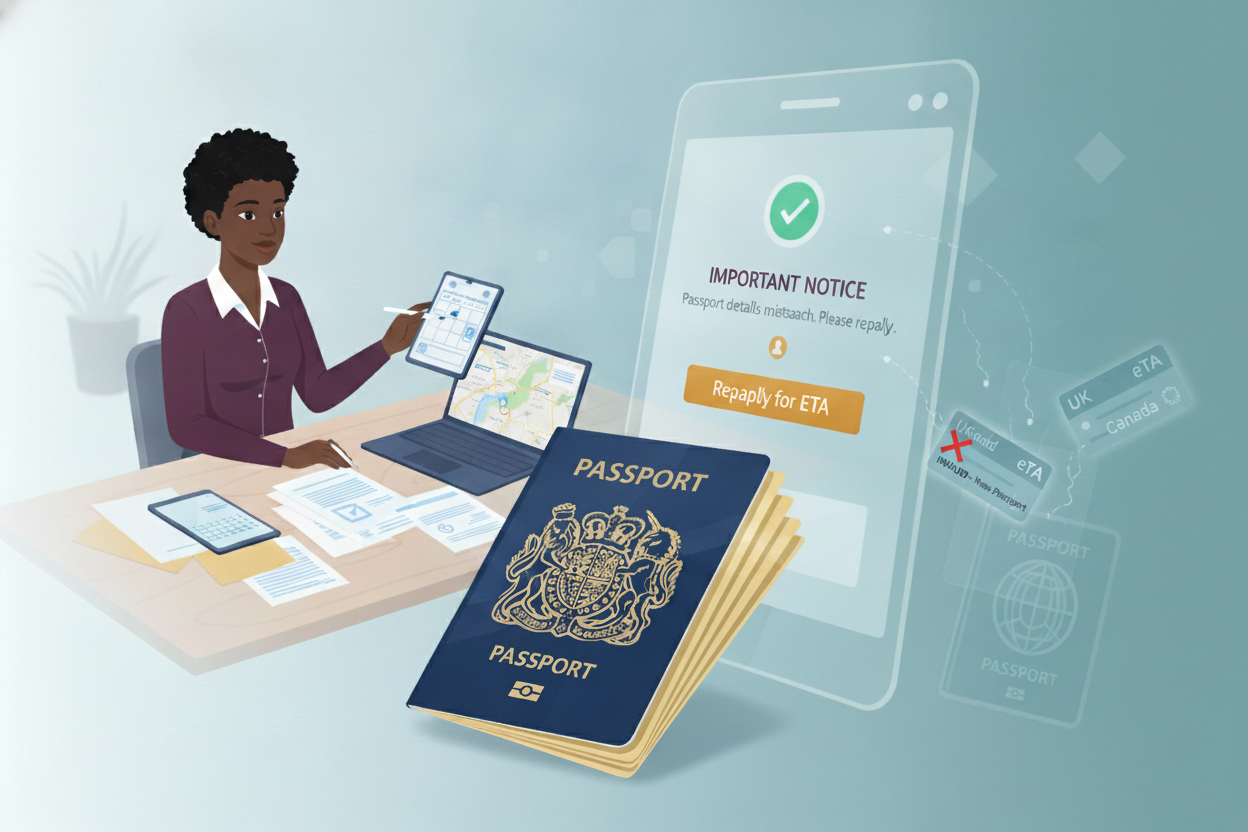
Short answer, up front: your ETA or eTA is tied to the exact passport you applied with, not to you in the abstract. Renew that passport, and any authorization linked to the old one may no longer work for travel, even if the approval email still looks current and the original validity period has not ended.
That is what makes this such an easy problem to miss. Passport renewal feels like good admin. It is good admin. Frequent travelers, international students, and skilled workers are often the people most likely to renew early, keep digital approvals filed neatly, and assume they are covered. Then the issue surfaces at the worst moment: online check-in fails, the airline cannot verify authorization, or a boarding agent tells you the passport in your hand does not match the authorization on record.
Nothing about that scenario feels intuitive until you understand the underlying rule: digital travel permissions are built around a specific passport record. If the document changes, your travel readiness may change with it.
For LiveMigrate readers, the practical lesson is simple: every passport renewal should trigger an immediate authorization review. If you hold a UK ETA, Canada eTA, or multiple visa-exempt travel permissions across different countries, this is one of the highest-value checks you can do before your next trip.
Why this matters more than travelers think
The main risk is not forgetting to apply in the first place. It is assuming that an approval you already received remains usable after a document change. Many travelers look at the email, the approval date, and the stated validity period, and conclude that nothing else matters.
In practice, airlines and border systems care about a match between the authorization record and the passport being presented. If those details no longer line up, the problem may appear long after the passport renewal itself.
Why organized travelers get caught
This issue often affects people who are otherwise careful:
- frequent flyers who renew passports early
- visa-exempt business travelers moving between countries regularly
- international students returning between term breaks
- skilled workers attending interviews, onboarding trips, or short assignments
- families managing several passports and approvals at once
The more experienced you are with travel, the easier it is to mistake stored approval evidence for current travel readiness.
The cost of discovering it late
The fallout is usually operational, not theoretical:
| What you expect | What can actually happen |
|---|---|
| Smooth online check-in | Check-in fails or requires manual review |
| Approval email proves you are covered | Carrier checks the current passport against the authorization record |
| Passport renewal reduces risk | It can create a fresh mismatch |
| Last-minute reapplication is a backup | Time pressure turns a fixable task into a travel-day problem |
The takeaway: this is not a niche technicality. It is a routine travel-readiness check that deserves a place on every post-renewal checklist.
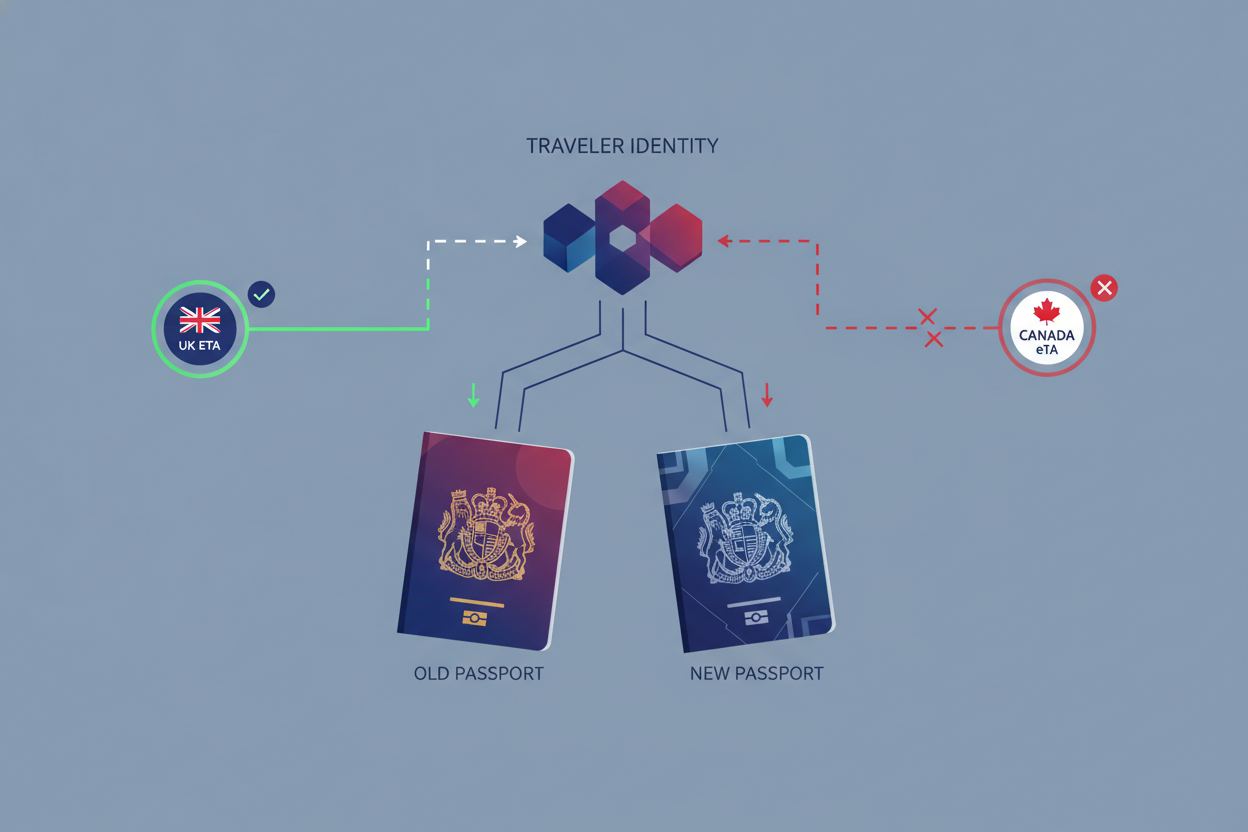
The core rule: Travel authorizations are passport-linked, not person-linked
A UK ETA or Canada eTA can feel personal because it was issued to you. Operationally, however, it is also document-specific. The application is built around passport details such as passport number, issuing country, name, date of birth, and expiry information.
That means the approval is not floating freely in your travel life. It is anchored to the passport used in the application. Change the passport, and you may break the match that carriers and border systems rely on.
What travellers usually assume
Most confusion comes from two understandable but risky assumptions:
- "It is valid until the expiry date, so my new passport should be fine."
- "If there were a problem, the system would probably notify me."
A validity period tells you how long an authorization may last under its own rules. It does not automatically mean any future passport can be used with it. And official systems are designed to process applications and issue decisions; they are not personal travel managers watching later changes in your documents.
A simple way to understand it
Think of your authorization like a digital key cut for one specific lock. You may still be the same traveler, but if the lock changes, the old key may no longer open it.
Practical examples
Here is how that logic plays out in common situations:
| Situation | Common assumption | Better interpretation |
|---|---|---|
| Authorization email still in inbox | I still have approval | You have proof of a past decision, not proof of current document match |
| Passport renewed early | I am reducing travel stress | You may need to review or reapply before your next trip |
| Multiple countries visited visa-exempt | Each authorization is separate | One passport change can affect several records at once |
| Same name and same nationality | The system should know it is me | Systems still rely on the passport record submitted |
The takeaway: if the passport changes, treat every linked authorization as needing review until confirmed otherwise.
How this fails in real life: Daniel’s Monday flight problem
Daniel is exactly the kind of traveler most people would describe as prepared. He flies often, including regular trips to London and Toronto. Because his passport allows visa-exempt travel, he holds two digital authorizations tied to that passport: a UK ETA and a Canada eTA. He applied through the official channels months apart. Both were approved. He filed the emails and moved on.
Then he renewed his passport ahead of schedule. The old one was filling up with stamps, and he did not want future travel disrupted by low validity or limited pages. Sensible move. Routine move.
What went wrong
What Daniel did not realize was that both authorizations were linked to the old passport. The approvals had not vanished from his inbox. No warning arrived. No dashboard connected the fact that he held two active authorizations against one passport that had now been replaced.
He only discovered the issue when preparing to board a UK-bound flight. The airline ran the authorization check against the passport he was actually using. The ETA record did not match.
Why the gate is where this shows up
Carriers do these checks because they have their own compliance obligations. If they board someone without the required authorization or a valid document match, the consequences are not just the traveler's problem. That is why a mismatch may surface before you ever reach border control.
The airport is the worst possible place to discover a document dependency you could have fixed calmly at home.
Why “usually quick” is not a travel strategy
In many straightforward cases, ETA-style applications may be processed quickly. But quick is not the same as guaranteed, and travel-day pressure magnifies every small problem:
- a payment card declines
- a name is typed incorrectly
- a passport number is entered with one digit wrong
- the photo or scan is unclear
- the application is pushed into additional review
- airport Wi-Fi fails when you need it most
The hidden chain reaction after a passport renewal
The passport itself is only the starting point. Once a new passport is issued, stale details can sit across several travel systems, quietly waiting to cause confusion later. Travelers often focus on the main authorization and forget all the surrounding records that also store passport data.
That is why one routine renewal can create multiple small failures across a trip.
What may need updating
Depending on your situation, the new passport may affect:
- digital travel authorizations such as ETAs and eTAs
- airline profiles and stored passenger records
- corporate travel systems or travel-desk files
- student travel and university admin records
- family bookings managed under one account
- saved details in booking platforms or travel wallets
Why frequent travelers are at higher risk
The more often you travel, the more fragmented your records become. One authorization may have been applied for last year, another during a work trip, another for an upcoming visit. They live in different emails, portals, screenshots, and memory.
Nothing about that setup naturally tells you, "These three approvals all depend on the same old passport number."
A practical audit mindset
Treat a passport renewal as a trigger event, not a filing task. The renewal itself is not the end of the job. It starts a short review across every place your old passport details may still be active.
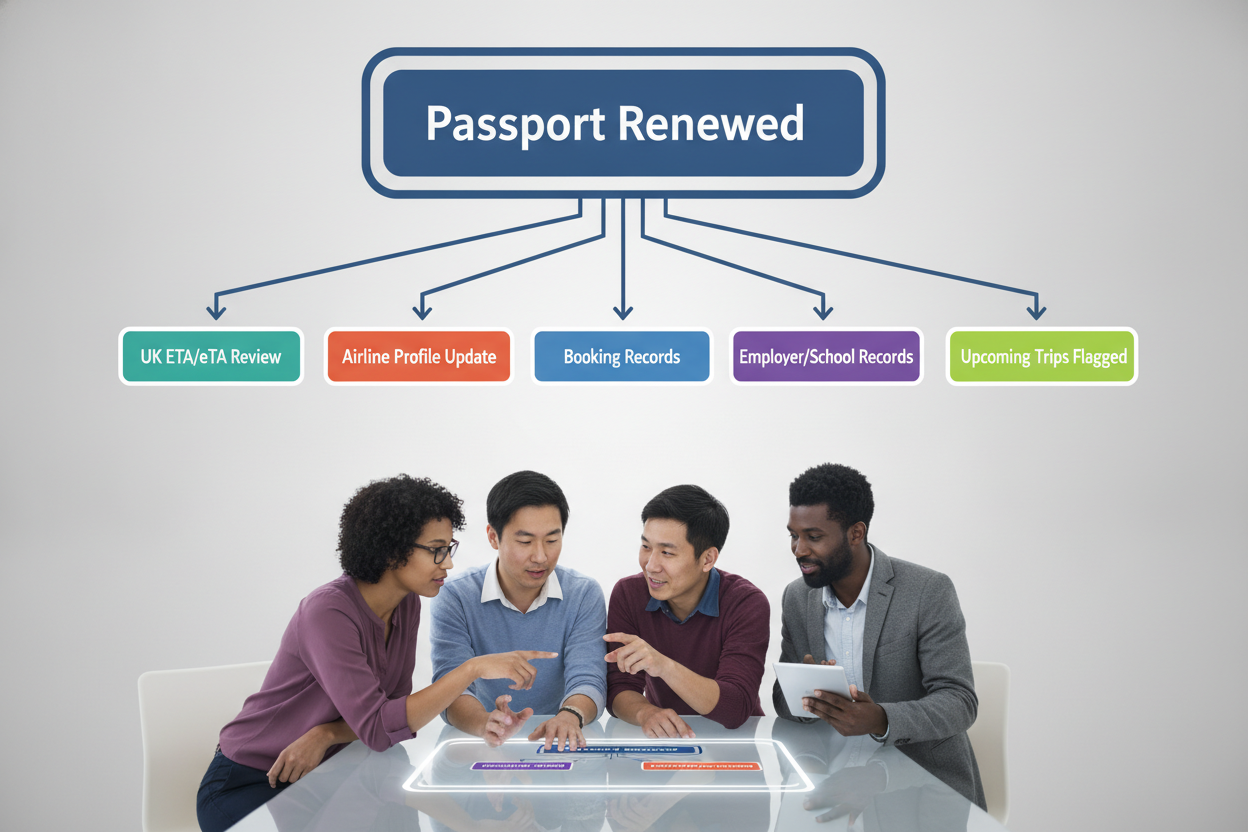
What a chain-reaction review looks like
| Item to review | Why it matters |
|---|---|
| Authorization tied to old passport | May no longer match the current travel document |
| Airline profile still storing old passport | Can create check-in confusion or repeated prompts |
| Family booking contains mixed passport details | Increases risk of one traveler being missed |
| Employer or school records outdated | Can slow support when travel needs to be changed quickly |
The takeaway: your passport number is not just a number. It is a shared identifier across multiple travel systems.
Why official systems cannot manage this for you
This is not really a criticism of official application channels. It is a reminder of what they are designed to do. Government systems generally process an application, assess it under their own rules, and issue a decision. That is their job.
Many travelers assume those same systems also monitor later events that make the approval less usable. Usually, they do not. That expectation gap is where problems begin.
The structural limitation
Official channels are typically transaction-based, not relationship-based. They may do one task well—accepting and processing an application—without acting as a long-term record layer across your wider travel life.
That matters because:
- a passport can change after approval
- you may hold several authorizations for different countries
- no single official site sees your whole travel admin picture
- systems do not necessarily connect your old and new documents across countries or trips
The distinction, plainly
| Need | Official application channel | Ongoing management layer |
|---|---|---|
| Submit an application | Yes | Can help organize inputs |
| Issue an approval | Government authority | No |
| Keep all your travel permissions in one place | Usually no | Yes |
| Notice one passport change affects multiple authorizations | Usually no | Yes, if designed for it |
| Reduce inbox-based confusion after approval | Limited | Strongly yes |
Where a platform like LiveMigrate fits
LiveMigrate is useful in the gap between approval and departure. It does not replace official decision-making. It helps reduce preventable errors, centralize records, and make later changes—like a passport renewal—visible before they become a missed-flight problem.
For a traveler like Daniel, that means:
1. one dashboard showing all active authorizations
2. a clear link between those authorizations and one passport record
3. reminders for passports expiration
4. an alert when that passport changes
5. faster reapplication workflows where needed
6. one place to store proof and status instead of hunting through old emails
The takeaway: official systems process applications; good travel management keeps watching what happens after issuance.
What most people still get wrong after learning the rule
Here is the contrarian part: even travelers who know authorizations are passport-linked still make mistakes. Knowledge alone does not fix the risk. The real challenge is timing, consistency, and record discipline.
Mistake 1: Waiting because the old approval still feels real
The old email is still there. The trip is still weeks away. The problem becomes a tomorrow task until tomorrow becomes airport day. This is the single most common failure mode.
Mistake 2: Assuming all destinations handle changes the same way
Travelers often generalize from past experience. If one visa, permit, or travel document seemed flexible, they expect the same everywhere. That is risky. Immigration systems are not interchangeable, and digital authorizations are especially vulnerable to document mismatches.
Mistake 3: Fixing only the authorization, not the ecosystem around it
Some travelers reapply correctly but forget to update airline profiles, loyalty accounts, or stored booking data. The result is a messy check-in experience where old passport details keep resurfacing.
Mistake 4: Thinking careful people are protected by default
In reality, careful people are often exposed precisely because they travel more, renew earlier, and manage more than one authorization at once. Complexity, not carelessness, is the real risk factor.
The danger is not ignorance. It is confidence built on records that are neatly saved but no longer current.
Where human oversight still matters
This is one of those travel problems no system fully solves without a human habit behind it. Someone still needs to ask the right question after a passport renewal: what else was tied to the old document?
That question matters whether you use a spreadsheet, a travel manager, or a platform like LiveMigrate.
The takeaway: learning the rule is step one; building a repeatable review habit is what actually prevents disruption.
A smarter way to manage multiple authorizations
If you travel internationally for work, study, family visits, or repeated short stays, stop treating digital authorizations like one-time forms that disappear after approval. They are active travel assets. They need to stay aligned with the passport you currently hold.
That mindset shift changes the way you prepare.
What a stronger system looks like
A better travel-admin setup usually includes:
- one list of all active authorizations
- a note of which passport was used for each application
- visibility into upcoming trips that depend on them
- a trigger to review all permissions after passport renewal
- easy access to current records without digging through inboxes
Why centralization matters
Centralization is not just about convenience. It reduces silent risk. When records are scattered, a passport renewal becomes invisible. When they are organized, the same event becomes actionable.

The LiveMigrate workflow advantage
A practical management flow for frequent travelers looks like this:
1. the passport is renewed
2. all linked authorizations are identified in one view
3. affected trips are flagged early
4. any needed reapplication is started with one click
5. current proof is stored accessibly for travel day
Why pre-submission validation matters too
Many authorization issues are not policy problems. They are data problems. A mistyped passport number, swapped name fields, or wrong expiry date can create avoidable stress. Systems that scan documents, prefill fields, and validate before submission reduce the most frustrating category of travel failure: the one caused by a typo under time pressure.
The takeaway: the best workflow is not just faster applications; it is fewer hidden mismatches after approval.
Your post-renewal action checklist
If your passport has changed, you do not need a complicated process. You need one calm, thorough review while you still have time. This section is the practical part to save and use.
The 8-step review
1. List your upcoming trips. Include destination and transit countries.
2. List all current authorizations. Think beyond the next flight.
3. Match each authorization to the passport used at application. Do not rely on memory.
4. Flag anything linked to the old passport. Review what must be redone.
5. Update airline and booking profiles. Replace stored old passport details.
6. Check work, school, or family travel records. Especially if others book on your behalf.
7. Take action early. Do not wait for check-in week.
8. Store current records in one place. Make travel-day access easy.
Quick self-audit
If you answer yes to two or more of these, do a full review now:
- Did I renew my passport after getting any ETA or eTA?
- Do I hold more than one active travel authorization?
- Do I have travel in the next few weeks or months?
- Am I relying on old approval emails rather than a current record system?
- Have I updated all profiles that store my passport details?
Savable review table
| Task | Done? |
|---|---|
| New passport checked for accuracy | |
| Active authorizations listed | |
| Old-passport-linked records identified | |
| Airline and booking profiles updated | |
| Employer, school, or family records updated | |
| Current proofs stored centrally |
One practical rule to remember
If you change the passport, review the permission. No exceptions, no assumptions, and no waiting until the week of travel.
The takeaway: this is one of the simplest high-impact audits in modern visa-exempt travel.
FAQ and final takeaway
FAQ
Does renewing my passport cancel my ETA?
Effectively, yes. A UK ETA or Canada eTA is linked to the specific passport used to apply. When you renew and receive a new passport number, the ETA tied to the old passport is no longer valid even if its validity period hadn’t ended. You’ll need a new ETA for the new passport.
If the authorization has not expired yet, can I still use it?
No. Validity dates are only one part of the picture; the passport match is the main indicator.
When do travelers usually discover the problem?
Often during online check-in, at the airline desk, or just before boarding when the carrier verifies authorization against the passport presented.
I hold authorizations for more than one country. Does renewing my passport affect all of them
Yes. Every authorization linked to that passport is affected at the same time. If you hold both a UK ETA and a Canada eTA on one passport, renewing it voids both
Will I be warned if my ETA becomes invalid?
Not by the official systems, their process ends at issuance. This is exactly the kind of change LiveMigrate is built to flag before you travel.
Is an ETA the same as a visa?
No. An ETA is a lighter, passport-linked authorization for visa-exempt travelers. It doesn’t guarantee entry, a border officer still decides and carriers check it before boarding.
Conclusion
Passport renewal is smart planning, but it can quietly break the document link that made a previous UK ETA or Canada eTA usable. That is why this issue catches capable travelers so often: nothing feels wrong until a system checks the new passport against an old authorization record.
The fix is usually far easier at your desk than at the gate. Review every authorization tied to the old passport, update the travel profiles around it, and resolve any needed reapplication before your next trip gets close.
If you travel often, manage family bookings, or juggle study and work trips across countries, move beyond inbox-based travel admin. Use a clear system to track which authorizations are tied to which passport and what changed after renewal. That is the practical gap LiveMigrate is built to help close.
CTA: Before your next booking or check-in, audit your current passport against every active authorization you hold. If you want one place to track those records, flag passport changes early, and reduce avoidable travel-day surprises, start with LiveMigrate.
Canada eTA
Ready to travel to Canada?
Apply for your Canada Electronic Travel Authorization online. Quick, guided, and approved in minutes.